
Breaking New Ground in Levodopa-Induced Dyskinesia (LID) in Parkinson’s Disease
We are driven to improve the health and well-being of all people affected by neuropsychiatric disorders.
About Us
We are committed to leading innovation in the neuropsychiatric disease field by advancing programs that target selective CNS circuits in the brain with clinically validated mechanisms of action. We believe this approach will help our therapies achieve better efficacy and tolerability, with the goal to deliver improved outcomes for patients.

Frank D Stonebanks
CEO

Dr. Randall D. Marshall
Chief Medical Officer

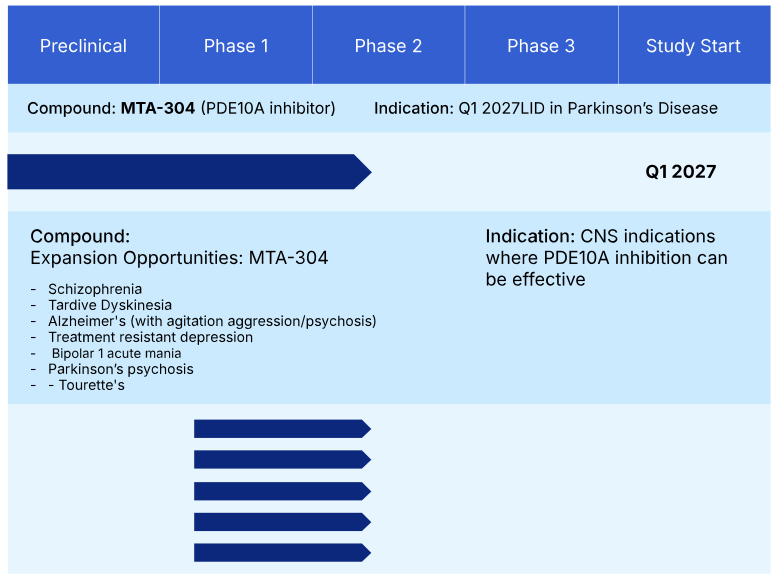
Our lead product, MTA-304, is a potentially groundbreaking advancement in LID treatment, with a new, differentiated PDE10A inhibitor.
Our Pipeline
MTA-304 is designed to reduce levodopa-induced dyskinesia (LID) in Parkinson’s disease by selectively inhibiting the PDE10A enzyme, which is highly concentrated in the striatum. Inhibiting PDE10A raises intracellular levels of the second messengers cAMP and cGMP. This modulates signaling in both the direct (D1) and indirect (D2) striatal pathways, helping to rebalance the abnormal corticostriatal activity that drives the involuntary movements of LID without broadly blocking dopamine receptors. Data to date show a superior safety and tolerability profile to standard of care medications for LID. Because the compound is highly potent and highly selective vs other PDE10A’s (with very high selectivity versus other PDE isoforms), it may achieve effective target engagement at lower doses and with fewer off-target effects than other, less selective PDE10A inhibitors. This could translate into a wider therapeutic window, better tolerability, and potentially more consistent anti-dyskinetic benefit while preserving the antiparkinsonian effects of levodopa.
Disease
- Tardive Dyskinesia
- Alzheimer's
(with agitation aggression/psychosis)
- Treatment resistant depression
- Bipolar 1 acute mania
- Parkinson’s psychosis
- Tourette's
In The News
Mentara Therapeutics Launches to Advance MTA-304, a Phase 2-Ready PDE10A Inhibitor, for Levodopa-Induced Dyskinesia in Parkinson’s Disease
-SPRIM Global Investments-backed company acquires asset from EuMentis Therapeutics-...